Conviction and locked stake
The locked stake features lets coldkey holders lock alpha stake to a specific hotkey on a subnet. Locked stake builds conviction, a score that grows over time toward the locked amount. Conviction provides a public, on-chain signal of long-term commitment that cannot be silently reversed.
Conviction provides information about subnet owners and other large investors in a subnet. A subnet owner whose alpha is locked has made a cryptographic commitment: unwinding a large position requires calling unlock_stake and then waiting through an exponential decay period before the stake can be withdrawn. This gives other stakers advance warning before any large exit completes.
Conviction staking is live on testnet (spec version 403) as of May 2026 and is tentatively scheduled for mainnet on May 13, 2026.
The stake lock mechanism
Locking stake binds a specific amount of a coldkey's staked alpha, on a subnet to a specific delegate (stake recipient) hotkey. The lock enforces one invariant:
Total alpha staked by the coldkey on that subnet ≥ locked amount
Everything above the locked amount is freely unstakable. The coldkey can also continue to stake additional alpha at any time: the lock only blocks the staked balance from dropping below the locked amount.
Locks are indefinite: they persist until the coldkey explicitly calls unlock_stake. There is no expiry and no need to periodically renew a lock.
One lock per coldkey per subnet is enforced. If a lock already exists for a coldkey on a subnet, additional lock_stake calls top up the locked amount (provided the hotkey matches the existing lock).
Conviction
The conviction score grows over time, from zero toward the locked amount. It therefore provides a combined signal of how long and how much a staker had invested in the subnet.
Growth follow an exponential curve:
where:
- : conviction at last update
- : conviction now
- : locked mass (alpha units)
- : blocks elapsed since last update
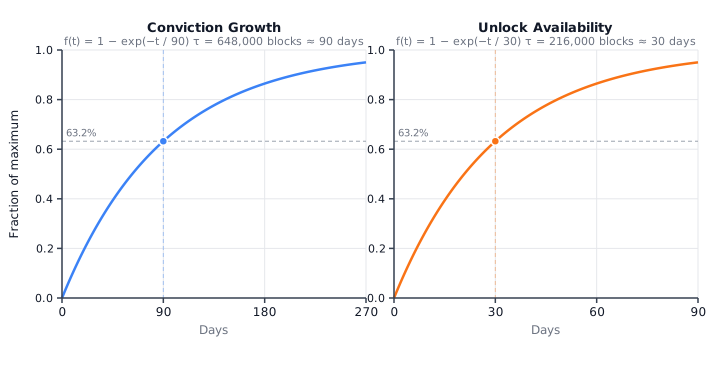
- : maturity time constant: 648,000 blocks (≈ 90 days)
Dynamics locking and unlocking
When someone locks stake, their conviction increases over time, up to the locked amount. When someone unlocks stake, their available unlocked stake increases over time up to the amount the just unlocked.
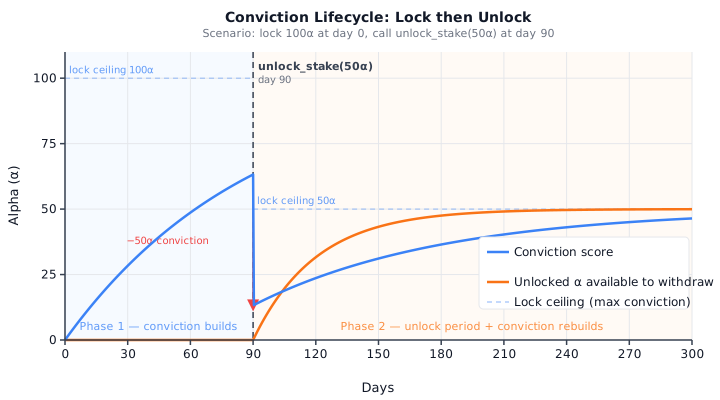
The same formula governs both curves, only the time constant differs. The lifecycle graph below shows how they interact in sequence:
Conviction growth: f(t) = 1 − exp(−t / τ), τ = 648,000 blocks ≈ 90 days. Dot marks one time constant (63.2% of max).
Unlock availability: f(t) = 1 − exp(−t / τ), τ = 216,000 blocks ≈ 30 days. Dot marks one time constant (63.2% of unlocked amount available). Both x-axes span 3τ.
See how it's calculated!
Scenario: lock 100α at day 0; call unlock_stake(50α) at day 90. Conviction (blue) drops instantly by the unlocked amount and then rebuilds toward the new lower ceiling. Unlocked α (orange) becomes gradually withdrawable over the following ~30 days.
To understand the design intent, notice that the math is about closing a gap, either gap between locked amount and eventual conviction, or unlocked amount and available amount.
If we re-arrange the equation to focus on the gap:
gap  = m - c0          (distance between current conviction and max)
c1   = m - gap × exp(-dt/τ)
exp(-dt/τ) is a number between 0 and 1, the fraction of the gap that remains after dt blocks.
So:
dt = 0→exp(0) = 1→ gap unchanged → c1 = c0 ✓dt = τ(90 days) →exp(-1) ≈ 0.368→ 36.8% of the gap remains → you've closed ~63% of itdt → ∞→exp(-∞) = 0→ gap gone → c1 = m ✓
Starting from c0 = 0 (fresh lock of 100 alpha):
gap = 100 - 0 = 100
at 90 days:  c1 = 100 - 100 × 0.368 = 63.2
at 180 days: c1 = 100 - 100 × 0.135 = 86.5
Conviction is always closing in on m, getting closer every block, never quite arriving.
Example: Lock 100 alpha at block 0 with no prior lock.
| Elapsed time | Conviction |
|---|---|
| 0 days | 0 |
| 30 days | ≈ 28.3 |
| 62 days | ≈ 50.0 |
| 90 days | ≈ 63.2 |
| 180 days | ≈ 86.5 |
| 270 days | ≈ 95.0 |
Maximum conviction equals the locked mass. Topping up an existing lock adds to locked mass immediately; conviction continues growing from its current value toward the new (higher) maximum.
Extrinsics
lock_stake
api.tx.subtensorModule.lockStake(hotkey, netuid, amount)
Locks amount alpha from the coldkey's stake on netuid to hotkey.
- If no lock exists for this coldkey on
netuid, a new lock is created with conviction 0. - If a lock already exists,
amountis added to the locked mass. The hotkey must match the existing lock. Usemove_lockfirst if switching hotkeys. amountmust not exceed the coldkey's available (unlocked) alpha on the subnet.
Errors:
InsufficientStakeForLock: available alpha is less thanamountLockHotkeyMismatch: a lock exists for a different hotkey on this subnetAmountTooLow: amount is zero
Event emitted: StakeLocked { coldkey, hotkey, netuid, amount }
unlock_stake
api.tx.subtensorModule.unlockStake(netuid, amount)
Begins the process of unlocking amount alpha from the coldkey's existing lock on netuid.
- Immediately reduces locked mass by
amountand conviction byamount. - The unlocked amount enters an exponential decay period. It becomes gradually withdrawable over time with a time constant of 216,000 blocks (≈ 30 days): roughly half is available after 30 days, ~86% after 60 days, and so on.
- While stake is in the unlocking period, it cannot be unstaked or re-locked. The available stake formula excludes both locked and unlocking amounts.
Errors:
UnlockAmountTooHigh: amount exceeds current locked mass
Event emitted: StakeUnlocked { coldkey, hotkey, netuid, amount }
Calling unlock_stake emits the StakeUnlocked event on-chain immediately, before any stake is actually withdrawable. This is by design: the unlock period exists specifically so that other stakers can observe the signal and act accordingly. An unlock by a subnet owner should be interpreted as a potential intent to reduce their position, not a completed exit.
move_lock
api.tx.subtensorModule.moveLock(destination_hotkey, netuid)
Reassigns the coldkey's existing lock on netuid from its current hotkey to destination_hotkey.
- Conviction resets to zero when the old and new hotkeys are owned by different coldkeys.
- Conviction is preserved when both hotkeys are owned by the same coldkey (moving between your own hotkeys).
- The locked mass and unlocking mass are preserved in both cases.
This gives the previous hotkey's stakers a window to react before conviction rebuilds on the new hotkey.
Errors:
NoExistingLock: no lock exists for this coldkey on the subnet
Event emitted: LockMoved { coldkey, origin_hotkey, destination_hotkey, netuid }
Locking stake does not change the amount of emissions you receive. Emissions are determined by stake weight and consensus participation. Conviction is a governance/signaling mechanism only.
Subnet owner auto-locking
When a subnet owner receives their distribution cut each epoch, it is automatically locked to the subnet owner's hotkey. If the owner already has a lock, the auto-lock tops it up using the existing lock's hotkey. If no lock exists, the auto-lock targets the subnet owner's hotkey.
This means subnet owners start accumulating locked alpha and conviction from the moment they own a subnet. Unlocking requires a conscious unlock_stake transaction followed by the 30-day unlock delay.
Key swap behavior
Hotkey swap (system-level): When a hotkey is swapped via btcli wallet swap-hotkey, all locks targeting the old hotkey are transferred to the new hotkey. Conviction is not reset, because the same coldkey owns both hotkeys.
Coldkey swap: A coldkey swap fails if the destination coldkey already has active locked mass on any subnet. The swap succeeds if the destination coldkey only has expired or zero-mass locks.
Transferring locked stake
When stake is moved to another coldkey within the same subnet, lock obligations follow the alpha proportionally. The runtime resolves how much of the transfer carries lock state:
- Freely available alpha transfers first: alpha above the locked + unlocking amount moves with no lock implications.
- Unlocking alpha is drawn next: if the transfer exceeds freely available alpha, the shortfall comes from the source's unlocking mass. That amount arrives at the destination still in its decay period.
- Locked alpha is drawn last: if the transfer still exceeds what's available, the remainder comes from locked mass. Conviction transfers proportionally. This step fails with
LockHotkeyMismatchif the destination coldkey already has a lock pointing at a different hotkey.
Cross-subnet moves are different: moving stake between subnets goes through unstake → TAO transfer → restake, which must satisfy ensure_available_stake. You cannot drag locked or unlocking alpha across subnets.
Querying conviction
Two runtime API calls expose conviction state on-chain:
| Method | Returns |
|---|---|
get_hotkey_conviction(hotkey, netuid) | Current total conviction for hotkey on netuid, summed over all coldkeys that have locked to it |
get_most_convicted_hotkey_on_subnet(netuid) | The hotkey with the highest conviction on netuid, or None if no locks exist |
Conviction is a rolling value, so querying at different blocks yields different results as time passes and the exponential grows.
Explorer tools like tao.app and taostats.io are expected to surface per-subnet lock state, including subnet owner lock percentage and conviction scores, providing investors with at-a-glance commitment signals.
Storage
Lock state is stored in two maps:
Lock[(coldkey, netuid, hotkey)]: per-coldkey lock record containing locked mass, unlocking mass, conviction score, and last update blockHotkeyLock[(netuid, hotkey)]: aggregate lock totals per hotkey (used for conviction queries without iterating all coldkeys)
The maturity time constant (MaturityRate) and unlock time constant (UnlockRate) are configurable runtime storage values, defaulting to 648,000 and 216,000 blocks respectively. These values can be adjusted by governance. The unlock and maturity windows are key parameters in the mechanism's attack surface, and tuning them changes how quickly conviction can build or unwind.
Appendix: implementation
The conviction formula is closed-form with no iteration or history, because the runtime stores only a checkpoint at the last mutation and evaluates forward on demand.
What's stored (LockState, lib.rs):
pub struct LockState {
    pub locked_mass: AlphaBalance,   // constant between user actions
    pub unlocked_mass: AlphaBalance, // amount pending the 30-day decay
    pub conviction: U64F64,          // c0: conviction at last_update
    pub last_update: u64,            // block number of last write
}
No history. Just a snapshot at a single block. The four fields are sufficient to reconstruct conviction at any future block.
The formula (calculate_matured_values, lock.rs):
let decay = Self::exp_decay(dt, tau);  // exp(-dt/tau)
let new_conviction =
    mass_fixed.saturating_sub(
        decay.saturating_mul(mass_fixed.saturating_sub(conviction))
    );
// = m - exp(-dt/tau) * (m - c0)
One call, no loop. This is the same equation shown in the Conviction section above.
On-demand evaluation (roll_forward_lock, lock.rs):
pub fn roll_forward_lock(lock: LockState, now: u64) -> LockState {
    let dt = now.saturating_sub(lock.last_update);
    let (new_unlocked_mass, new_conviction) =
        Self::calculate_matured_values(
            lock.locked_mass, lock.unlocked_mass, lock.conviction, dt,
        );
    LockState {
        locked_mass: lock.locked_mass,
        unlocked_mass: new_unlocked_mass,
        conviction: new_conviction,
        last_update: now,
    }
}
The mutation pattern (from do_lock_stake, lock.rs):
// Roll to current block before modifying
let lock = Self::roll_forward_lock(existing, now);
let new_locked = lock.locked_mass.saturating_add(amount);
Self::insert_lock_state(coldkey, netuid, hotkey, LockState {
    locked_mass: new_locked,
    unlocked_mass: lock.unlocked_mass,
    conviction: lock.conviction,  // current conviction becomes new c0
    last_update: now,             // checkpoint resets to now
});
Every mutation (lock_stake, unlock_stake, move_lock) calls roll_forward_lock first. This advances conviction to the current block and writes it as the new c0. From that point, the stored (c0, m, last_update) triple is sufficient to evaluate conviction at any future block without needing history.
Conviction is therefore a pure function of elapsed time between mutations. Given the stored checkpoint, conviction at any future block b is:
c(b) = m - (m - c0) × exp(-(b - last_update) / τ)
This is exactly what get_hotkey_conviction evaluates when queried. You can also project forward: if no mutations occur between now and block b, the formula gives the exact future conviction. A mutation (top-up, partial unlock, move_lock) resets c0 and last_update to a new checkpoint, restarting the forecast from there.